
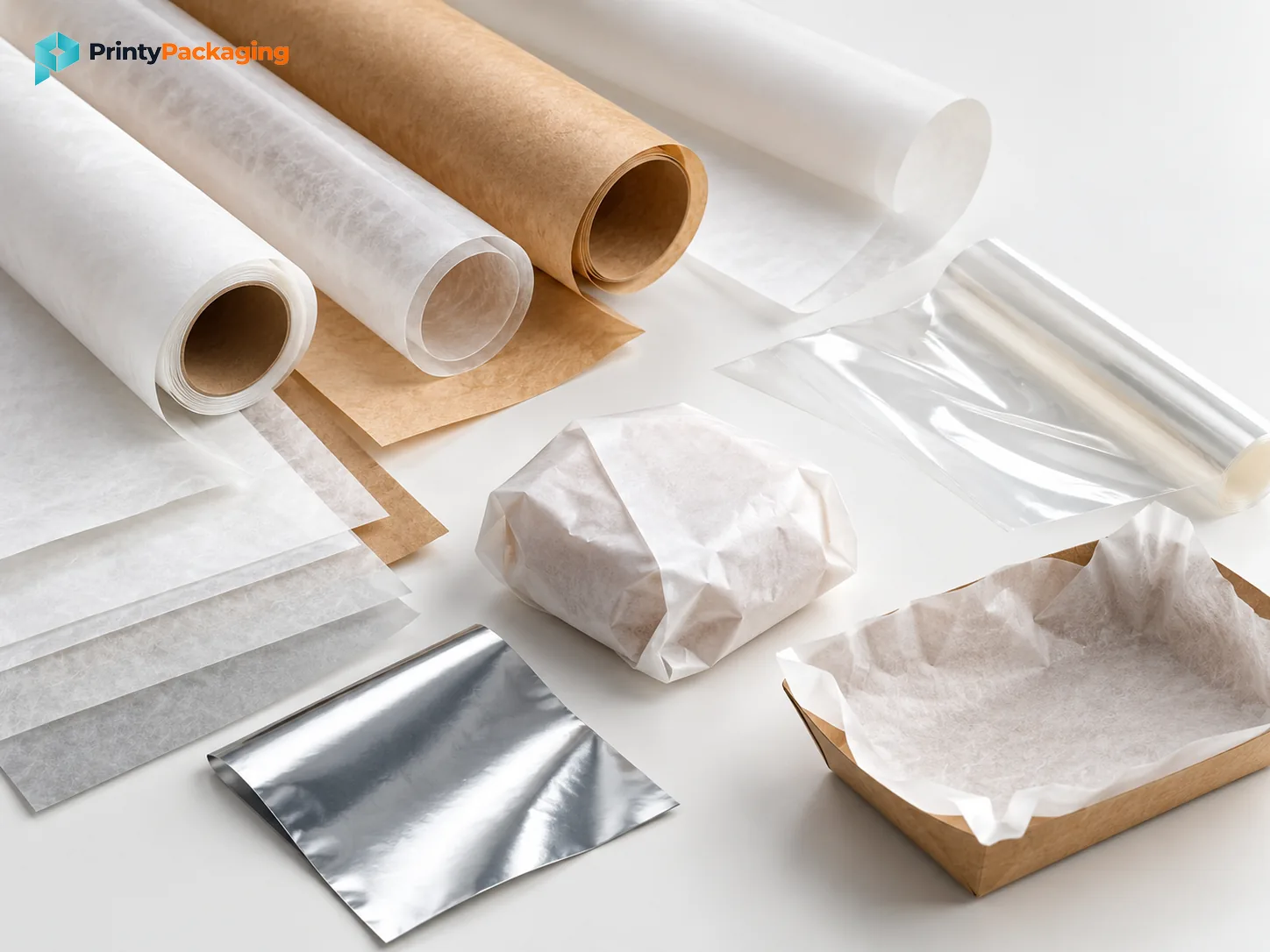
Why this question comes up so often
Almost every restaurant or bakery that asks us for printed wrapping paper uses a different name for it. One owner says butter paper, the next says wax paper, a third calls it deli paper, and a burger chain in the UK will ask for greaseproof.
They are not always talking about the same thing. And the difference matters more than people expect, because the wrong paper either soaks through with oil in ten minutes or costs you twice as much as it should.
So before you send artwork anywhere, it is worth spending five minutes on what each paper actually is.
The short answer
If you only read one part of this article, read this table. It covers the three papers food brands ask about most.
| Butter paper | Wax paper (deli paper) | Greaseproof paper | |
|---|---|---|---|
| What it is | Thin, smooth paper made from tightly refined pulp, no wax coating | Thin paper coated on one or both sides with food-grade wax | Dense paper refined or treated to stop oil passing through |
| Holds back grease | Moderate | Good on the waxed side | Best of the three |
| Safe in the oven | Short, low heat only | No, the wax melts | Yes, most grades |
| Feels like | Soft, slightly see-through | Slightly slick, a little shiny | Crisp, a bit stiffer |
| Typical GSM | 30 to 40 | 25 to 35 | 35 to 50 |
| Best for | Sandwiches, wraps, bakery items, tray liners | Burgers, deli sandwiches, basket liners | Fried food, oily pastries, fish and chips |
| Print result | Clean, good for logos and patterns | Good, colours look a little softer | Very clean and sharp |
Butter paper: the everyday choice
Butter paper is what most cafes and sandwich shops in South Asia and the Middle East mean when they say food paper. It is light, it folds easily, and it prints well, which is why it is often the cheapest way to get your logo into a customer's hand.
The catch is grease. A dry sandwich or a croissant is fine. A double smash burger with sauce is not, and you will see oil marks through the paper before the customer reaches their table. If your menu is mostly dry or lightly oily food, butter paper is the sensible pick.
Wax paper: the burger and deli favourite
Wax paper, which the US market usually calls deli paper, has a thin food-grade wax layer. That layer is what stops sauce and moisture coming through, and it is why nearly every burger place in the States wraps with it.
Two things to know. First, wax paper must never go in an oven or a hot press, because the wax melts onto the food. Second, printing sits on top of a slightly slick surface, so very fine text and thin lines can soften. Keep your logo bold and your small print to a minimum.
Greaseproof paper: when food is really oily
Greaseproof paper is made dense enough that oil struggles to pass through it, without needing a wax coating. It is the paper behind fish and chips wraps, fried chicken liners and pastry bags in the UK and Europe.
It costs more per sheet than butter paper. For fried food though, it is usually cheaper in the long run, because customers stop getting oily hands and you stop double-wrapping. If you ask a supplier about grease resistance, the term to use is KIT rating. A higher KIT number means stronger resistance to oil.
What GSM should you ask for?
GSM is simply the weight of the paper, grams per square metre. A higher number means a thicker sheet, and a thicker sheet costs more.
For most wraps, 30 to 35 GSM is plenty. It folds neatly around a burger without cracking at the corners. Go up to 40 to 45 GSM if the paper doubles as a tray or basket liner, where it needs to sit flat and not tear when someone picks up their food. Only go heavier than that for oily fried food or if the sheet has to hold its shape in a bag.
A mistake we see a lot is brands choosing the thickest paper to feel premium. On a wrap, thick paper fights you when you fold it and makes the parcel look bulky. Thinner and well printed usually looks better.
Sizes that actually work
There is no single standard, but these sizes cover most orders. If you are not sure, wrap your biggest menu item in a sheet of plain paper and measure what you used, then add an inch.
| Size (inches) | Size (cm) | Good for |
|---|---|---|
| 10 x 10 | 25 x 25 | Small burgers, sliders, cookies, pastry wraps |
| 12 x 12 | 30 x 30 | Standard burgers, basket liners, most sandwiches |
| 14 x 14 | 35 x 35 | Large burgers, loaded wraps, double patties |
| 12 x 16 | 30 x 40 | Long subs, hot dogs, deli sandwiches |
| 15 x 20 | 38 x 50 | Tray liners, sharing platters |
Printing tips that save money
One or two colours is often all you need. A repeating logo pattern in your brand colour looks deliberate and is cheaper than full-colour artwork. Food paper is also thin, so heavy ink coverage can make the sheet feel stiff.
Leave the centre lighter. The middle of the sheet is where the food sits and where grease shows first. A pattern that is denser at the edges and lighter in the middle hides marks better.
Ask for food-safe inks, and ask the supplier to confirm it in writing. In the US, paper that touches food falls under FDA food contact rules. In the UK and EU the reference is regulation EC 1935/2004. A good supplier will not be bothered by the question.
Finally, send your artwork as vector files (AI, PDF or SVG) so the logo repeats cleanly across the sheet.
So which one should you choose?
If you sell sandwiches, wraps, baked goods or anything that is not dripping with sauce, start with butter paper. It is the cheapest way to put your brand on every order.
If you sell burgers, deli sandwiches or anything saucy, go with wax paper and keep your artwork bold.
If your food is fried or properly oily, pay the bit extra for greaseproof. Your customers' hands and your reviews will thank you.
Still not sure? Send us a photo of the food you want to wrap and roughly how many you sell in a month. We will suggest the paper, the size and a sensible first order quantity, with a free mockup of your logo on the sheet.
Need Packaging Help?
Send your packaging details for quote support.
Share size, quantity, material, printing, finishing, artwork status and delivery country for better guidance.
Request Quote